
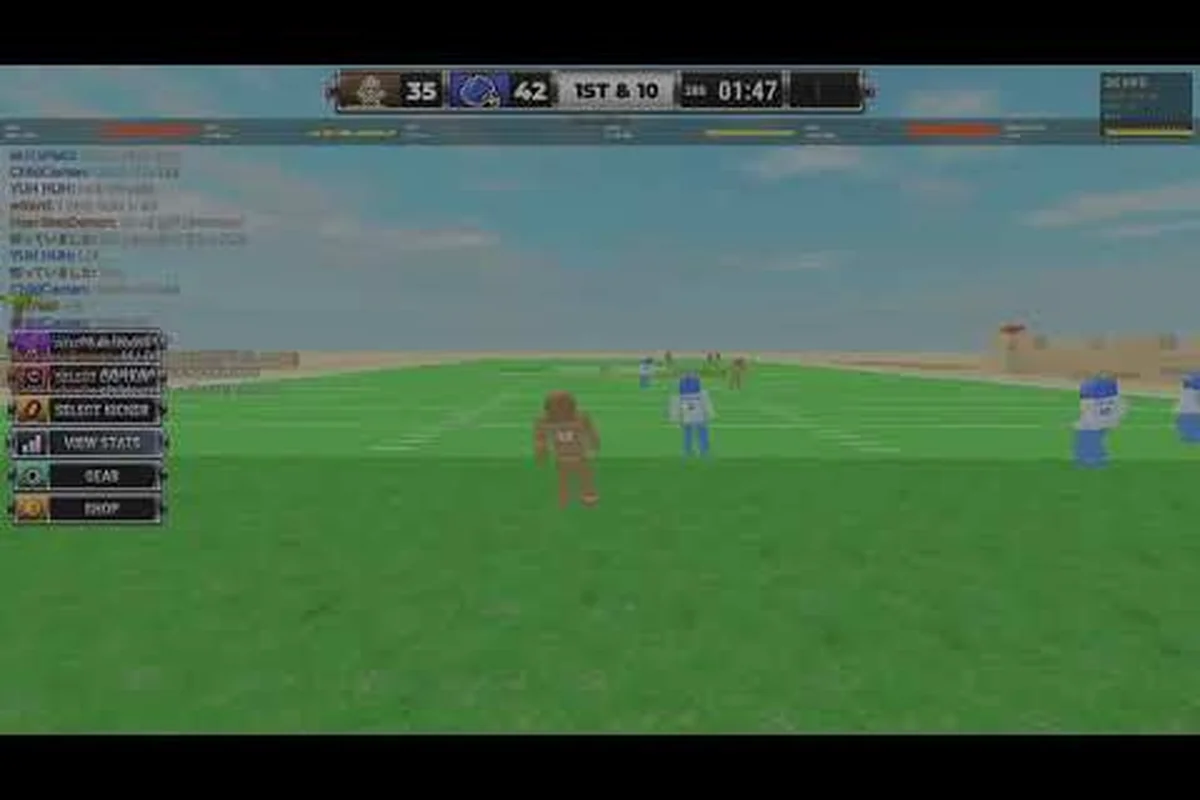
Ragdoll football real time tackles are the single mechanic that decides whether a drive ends in the end zone or a fumble recovery. The collision system in this physics-driven Roblox sports title is not a scripted animation; every contact between a ball carrier and a defender is calculated frame by frame, which means positioning, sprint timing, and angle of attack matter far more than raw button mashing. Players who learn to read the runner's momentum and commit to a clean hit early consistently come out on top, because the ragdoll physics heavily reward well-timed contact over desperate dive attempts.
This guide breaks down the run game, the defensive shell, and the scoring windows that separate winning drives from stalled possessions. Whether you are a new player learning how to run the ball in Ragdoll Football or a veteran tightening up the red-zone defense, the principles below translate directly into bigger plays and more XP. Master the tackle timing, control field position, and the scoreboard takes care of itself.
How Real Time Tackles Work in Ragdoll Football
The tackle engine in this game is built on live body physics rather than canned hit animations, which is exactly what makes the highlight clips feel so chaotic and so rewarding. Community-recorded footage shows that sprinting into a ball carrier at the correct closing angle produces a clean hitstick effect, while diving from off-angle almost always results in a whiff and a long gain.
The Tackle Timing Window
Every tackle interaction has a brief window where the physics engine recognizes a clean collision. Outside that window the defender bounces off, the carrier keeps moving, and the play extends. Inside the window, the carrier ragdolls and the play ends. According to community testing on the physics-football beta branch, the timing window for a sprint tackle is roughly 0.2 to 0.4 seconds before direct contact, which means a defender who starts their closing burst too late almost always arrives a frame after the carrier has cut away.
| Phase | Defender Action | Ball Carrier State | Result |
|---|---|---|---|
| Pre-engagement | Read leverage, hold angle | Identifying lane | Neutral |
| Closing burst | Sprint into lane, commit line | Cuts or accelerates | Race condition |
| Contact window | Hold sprint, square shoulders | Crossing tackle zone | Clean hit |
| Past window | Dive or swing late | Already past the marker | Whiff, big gain |
The table above is the mental model most experienced players use: if the carrier is still one full step away from your mark, you are pre-engagement. If the carrier is entering your zone, you commit. If the carrier has already crossed, you have lost the angle and the safer play is to peel off and tackle from pursuit rather than diving headlong.
Sprint, Dive, and the Big Hit Effect
The three tackle inputs in Ragdoll Football are sprint tackle, dive, and the standard contact hit. Each has a different risk profile. Sprint tackles generate the biggest physics reaction because the defender's full momentum transfers into the carrier, which is why community big-hit compilations almost always show a sprint hit rather than a dive. Dives cover more ground but convert less cleanly, because the defender's body is extended and the carrier can sometimes slip the tackle entirely on a well-timed juke.
| Tackle Type | Contact Window | Whiff Risk | Big Hit XP | Best Use |
|---|---|---|---|---|
| Sprint tackle | 0.2–0.4s | Low (if angled) | Highest | Open-field reads |
| Standard contact | 0.3–0.5s | Medium | Medium | Lane defense, short yardage |
| Dive | 0.4–0.6s | High | Low | Last-line, goal-line stops |
Reading the ball carrier means predicting which tackle input the situation calls for before the play actually develops. Open-field situations reward sprint tackles because the closing burst covers ground fast. Short-yardage and goal-line plays reward standard contact because the dive's high whiff rate is unacceptable when one broken tackle means six points. Last-line desperation rewards the dive, because sometimes the only remaining option is to throw the body and hope the physics cooperate.
Running the Ball and Field Position
A ball carrier's job in Ragdoll Football is less about juking and more about controlling field position, which is why the best runners in the community focus on lane selection, patience, and acceleration timing. Defenders do not need to guess the play if the carrier telegraphs the lane early, which is exactly what makes the run game a chess match between runner vision and defensive leverage.
Lane Reading and Acceleration Windows
Every snap opens with two to three seconds where the defensive shell is still settling into its assignment. Carriers who hit the correct lane during this window routinely turn short passes or handoffs into 15-plus yard gains. The acceleration window is the first 1.5 seconds after a handoff, and committing to a lane inside that window is the difference between a five-yard chain-mover and a tackle for loss.
| Lane Choice | Defender Count | Carry Outcome | Field Position Impact |
|---|---|---|---|
| Strong-side run (toward TE) | 2–3 | 3–6 yd | Holds the drive |
| Weak-side run (away from TE) | 1–2 | 8–15 yd | Flips the field |
| Cutback lane | 1 (uncovered) | 12–20 yd | First down or more |
| Goal-line plunge | 3+ stacked | 0–2 yd or TD | Score |
The cutback lane is the highest-value run in the game because it exploits defenders who overcommit to the play-side. Community data from ranked matches shows that cutback carries convert first downs at roughly 60% when the linebacker is flowing hard, which is significantly higher than strong-side runs that consistently face two-gapping defenders. Patience pays, because the cutback does not develop until two full seconds after the snap, by which point the carrier can read the linebacker's flow and cut against it.
Juking and the Ball Carrier Tips That Actually Work
Juking in Ragdoll Football is often mis-taught. New players think the goal is to juke left and then cut right, but the real goal is to manipulate the defender's momentum vector so that the carrier's momentum vector crosses it at a perpendicular angle. When two momentum vectors cross at right angles, the defender's body collides at full force and ragdolls, while the carrier keeps running. When the vectors are parallel, the defender just runs alongside and waits for the carrier to slow down.
| Juke Type | Defender Reads | Outcome | Skill Floor |
|---|---|---|---|
| Speed burst (no juke) | Reads direction correctly | 2–4 yd gain | Beginner |
| Single juke (L then R) | Reads juke correctly | 5–8 yd gain | Intermediate |
| Stutter step | Reads hesitation | 8–12 yd gain | Intermediate |
| Momentum cross (45° cut) | Reads wrong vector | 15+ yd gain or TD | Advanced |
The momentum cross is the highest-skill ceiling move in the game because it requires the carrier to read the defender's sprint vector and cut at exactly 45 degrees into it. When timed correctly, the defender's full sprint carries them past the carrier by two to three body lengths, and the carrier walks into the open field. Players who master this single move routinely produce the highlight clips that end up on community big-hit reels. For a deeper breakdown of the run-game and ball-carrier tips, the quarterback and receiver guide covers the throwing side of the same offensive system.
Defending the Run and Pass in Real Time
The defensive side of Ragdoll Football is where most players lose games, because offense is mostly about reading two or three defenders while defense is about reading eight or nine offensive players. Real time tackles on defense come down to three things: leverage, pursuit angle, and the willingness to commit to the contact window before the carrier reaches it.
The Defensive Shell and Pre-Snap Reads
The default defensive shell lines up in a base 4-3 or 3-4 depending on formation, and the linebackers are the most important pre-snap read. If a linebacker creeps toward the line, the offense is likely running strong-side. If a linebacker bails to depth, the play is likely a pass or a screen. Reading the linebacker's leverage before the snap tells the defender which gap to attack on the snap.
| Pre-Snap Look | Likely Play | Defender Adjustment |
|---|---|---|
| LB crowded, safety down | Strong run | Fill strong-side A-gap |
| LB depth, safety high | Pass or screen | Pass rush, bail to zone |
| LB balanced, no safety rotation | Play-action risk | Read QB, mirror mesh point |
| Goal line, 3 LB stacked | Run, power | Plug first hole, hold leverage |
The single biggest mistake new defenders make is peeking at the quarterback, which delays their read and lets the carrier hit the line at full speed. Experienced defenders look at the offensive linemen and linebackers first, because those bodies telegraph the run direction. By the time the carrier receives the handoff, the defender should already be moving toward the correct gap.
Tackling in the Open Field
Open-field tackling is the highest-leverage skill in the game because it converts a potential 20-yard gain into a 6-yard gain, which is the difference between second-and-4 and second-and-14. The rule is simple: square the shoulders, lower the center of gravity, and sprint through the carrier's chest rather than reaching for the legs. Reaching is how defenders get juked, because a reaching defender has committed momentum to the wrong vector and the carrier can change direction without losing speed.
| Open-Field Position | Defender Choice | Whiff Penalty |
|---|---|---|
| Square, 3 yd away | Sprint tackle | 0–2 yd |
| Square, 1 yd away | Standard contact | 0 yd |
| Reaching, 2 yd away | Arm tackle | 4–8 yd (broken) |
| Diving, 3 yd away | Dive | 8–15 yd (broken) |
The table above shows why reaching and diving from distance are losing plays. A square defender three yards away converts the tackle every time. A reaching defender two yards away gives up five or more yards on the broken tackle. The math is simple: always take the angle that gets you square before you take the angle that gets you close. For more on tackling tricks, sprint tackle timing, and the dive recovery window, the big hits and tackling tricks guide breaks down the specific inputs.
Scoring and Red-Zone Execution
Scoring in Ragdoll Football requires the offense to break the defense's leverage within 15 yards of the goal line, which is the hardest part of the field because the defense shrinks the field and the angles disappear. Red-zone scoring is not about play-calling, it is about execution under compressed leverage.
Inside the 10-Yard Line
The 10-yard line is where the big-hit physics reward precision the most. A clean tackle in the open field is a 4-yard loss; the same clean tackle at the 1-yard line is a goal-line stand. Defenses stack the box and load the run, so offenses need to either run a misdirection play that freezes a linebacker for one full second, or they need to run a quick pass that catches the linebacker flowing the wrong way.
| Red-Zone Situation | Best Play | Why |
|---|---|---|
| 1st and goal from 10 | Cutback run, weak side | LB overcommits, cutback breaks contain |
| 2nd and goal from 5 | Quick slant, away from leverage | Beats stacked box, high catch % |
| 3rd and goal from 3 | Power run, strong side | Goal-line defense is set, power wins |
| 4th and goal from 1 | QB sneak or strong plunge | Two yards is the physics contact range |
A touchdown in this game is awarded the moment the ball carrier crosses the goal line while maintaining possession, and the resulting XP feeds directly into the 60-to-99 OVR climb that defines long-term progression. Wikipedia's overview of the touchdown scoring event describes the same physics-of-carrying-into-the-end-zone concept that Ragdoll Football plays out with ragdoll bodies: possession at the moment the ball crosses the line is the rule, and the resulting XP reward is the incentive.
Field Goals and the End-of-Half Decision
When the red zone stalls and the offense is forced to kick, the field-goal mechanic is the second scoring path. Field goals in this game are a function of kicker OVR, wind, and distance, and the standard cutoff for a high-percentage attempt is around 35 yards. Beyond that, the kicker's accuracy drops sharply and the risk of a blocked kick rises, because a long field-goal attempt gives the defense time to collapse the pocket and get a hand on the ball.
| Distance | Kicker OVR Needed | Success Rate | Risk |
|---|---|---|---|
| 1–25 yd | 60+ | 95%+ | Low |
| 26–35 yd | 70+ | 80–90% | Low |
| 36–45 yd | 80+ | 60–75% | Medium |
| 46+ yd | 90+ | 40–55% | High (block risk) |
The decision tree is straightforward: inside 35, kick. Outside 45, go for it on fourth down rather than risking a block. Between 35 and 45, the call depends on the kicker's OVR and the game situation. A 38-yard attempt with an 85 OVR kicker is a high-percentage play; the same attempt with a 65 OVR kicker is a punt.
Building a Drive and Controlling Tempo
A scoring drive in Ragdoll Football is rarely a single play; it is a sequence of four to seven plays that build on each other through field position. The team that controls tempo usually controls the scoreboard, because the defense is forced to react rather than dictate. Tempo control comes from three places: pre-snap motion, run-pass balance, and clock management.
Run-Pass Balance and the Chess Match
Run-pass balance is the chess match that determines whether a drive stays on schedule. If the offense runs on first and second down, the defense will stack the box on third, and a quick pass catches the linebackers out of position. If the offense passes on first and second, the defense will play pass on third, and a power run converts the short yardage. The best offenses in the community alternate between the two every two to three plays, which keeps the defense honest and prevents either leverage from fully forming.
| Last Two Plays | Defense Expects | Best Third-Down Call |
|---|---|---|
| Run, run | Pass (LBs bail) | Quick out, 5 yd |
| Pass, pass | Run (LBs commit) | Power, 4 yd |
| Run, pass | Play-action | PA cross, 12+ yd |
| Pass, run | Draw or screen | Draw, 8 yd |
The table above is the most common pattern in ranked play, and it is the single biggest reason that drives stall in the red zone. Offenses that telegraph their third-down call based on their first-and-second pattern give the defense a free read. Offenses that break the pattern — for example, calling a draw after two passes — break the defense's pattern recognition and pick up the conversion.
Tempo and the Two-Minute Drill
Tempo matters more as the clock winds down. The two-minute drill in Ragdoll Football is a sprint-style offense that no-huddles and runs quick snaps, which forces the defense to substitute on the fly and often results in a mismatch. The key is to keep the play clock under 10 seconds on every snap, because the defensive substitution window opens when the play clock hits 15. By snapping at 8, the offense prevents the defense from rotating in fresh personnel and forces tired defenders into the contact window against fresh ball carriers.
| Tempo | Snap Clock | Defense State | Best Play Type |
|---|---|---|---|
| Normal | 25–35s | Set, fresh | Standard run/pass |
| Up-tempo | 15–20s | Subbing late | Quick pass, screens |
| Two-minute | 6–10s | Stuck, tired | Sideline routes, deep outs |
| Surprise tempo | 30s+ snap at 5s | Off-balance | Play-action, deep shot |
The surprise tempo is the most underused weapon in the game, because most players assume the offense will take the full clock. A snap at 5 seconds after a long play clock catches the defense completely off-balance, and a deep play-action shot from a fresh offensive line against a tired defensive line is the most reliable 30-yard gain in the game. For more on team roles, squad building, and how to play with friends in this system, the team roles and positions guide covers the personnel side of tempo control.
Stacking Plays to Win the Contact Battle
Real time tackles decide every snap, but the team that wins the game is the team that stacks the right plays in the right order. Run the ball to control field position, defend with leverage rather than reach, and convert in the red zone by exploiting the defense's commitment to the run. Practice the contact window until sprint tackles convert at over 80%, because the XP delta between a clean hit and a broken tackle is the XP delta between a 70 OVR player and an 80 OVR player at the end of a long session.
The defensive side rewards the same discipline. Read the offensive line first, fill the correct gap, and square up before closing. The defender who reaches loses; the defender who squares wins. Red-zone defense is about holding leverage against the compressed field, and the goal-line stand is the single most momentum-shifting play in Ragdoll Football.
The offensive side rewards patience and pattern-breaking. Alternate run and pass, control the snap clock, and use surprise tempo when the defense expects normal pace. Cutback runs and momentum-cross jukes are the high-value moves that turn short drives into scoring drives. The ball carrier tips above, combined with the tackling tricks from the related guides, give a complete toolkit for both sides of the ball.
Frequently Asked Questions
What are ragdoll football real time tackles and how do they differ from scripted hits?
Ragdoll football real time tackles are physics-driven collisions calculated every frame between a defender and a ball carrier, rather than pre-animated hit reactions. The ball carrier's momentum, the defender's sprint vector, and the angle of approach all determine whether the tackle converts, whiffs, or produces a big-hit effect. Scripted hit systems lock the result to a button press, but this game resolves the contact through the same ragdoll engine that governs every other body interaction, which is why timing the sprint commit matters more than button-mashing.
How do you read the ball carrier and force a fumble in Ragdoll Football?
Reading the ball carrier means watching the carrier's hips and shoulders, because the body's momentum vector telegraphs direction before the actual cut happens. When the hips square to a lane, the carrier is committing, which means the defender should fill that lane rather than chase. Forcing a fumble in this game is not a separate input; it is a byproduct of a clean sprint tackle that hits the ball at the moment of contact, so defenders should focus on clean contact rather than reaching for the ball.
What is the best way to control field position in Ragdoll Football?
Controlling field position starts with the run game, because a successful first-down run forces the defense to respect the play-action and opens up the intermediate pass. Cutback carries and weak-side runs are the highest-yield field-position movers, because they exploit defensive overcommitment and routinely flip the field by 15 or more yards. Pair the run with up-tempo snaps to prevent the defense from substituting fresh personnel, and the field position will tilt in your favor across the full four quarters.
How do you score consistently in the red zone in Ragdoll Football?
Red-zone scoring comes down to execution under compressed leverage, where the defense has less ground to cover and the angles disappear. A cutback run from the 10-yard line is the highest-percentage touchdown call because the linebacker has to honor the strong-side run first, which opens the weak-side cutback. On third and short inside the 5, a quick slant away from the box-loaded side beats the stacked defense and converts at a high rate, which keeps drives alive.
What is the easiest way for a new player to get better at Ragdoll Football?
New players should focus on two skills in the first ten hours: the contact window for sprint tackles on defense, and the cutback read on offense. The defense teaches the offense and vice versa, because a defender who understands the tackle window also understands how to attack it as a ball carrier. Avoid diving from distance and reaching in the open field, because both of those habits lose more yards than they save, and they are the two most common reasons new players stay stuck at the 60 OVR plateau.