
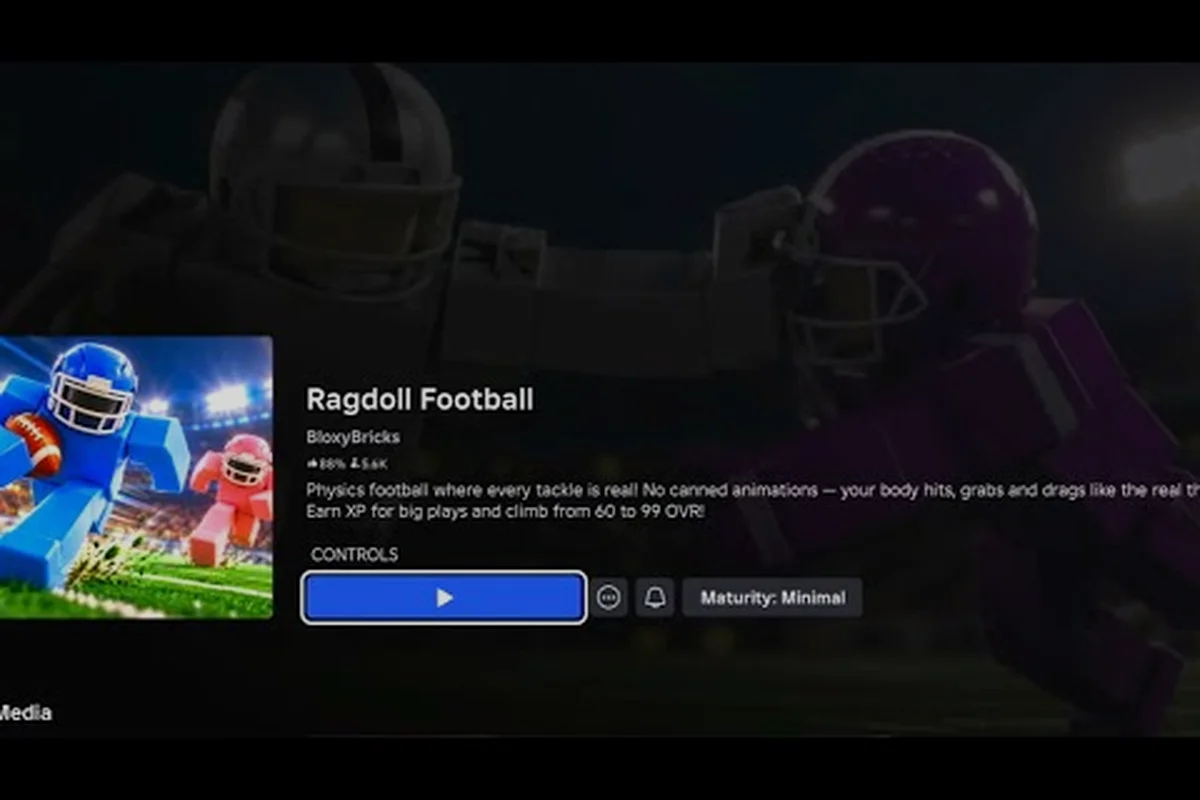
Every yard in Ragdoll Football is shaped by the role you pick before the snap, because the physics engine hands each position a distinct toolset. Knowing ragdoll football player roles inside and out is the difference between a thrown ball sailing into the second row and a clean six points. This guide maps every offense and defense slot, shows the routes a deep threat runs versus the reads a pocket passer makes, and explains how coverage responsibilities shift when linebackers drop into zone. Use it as a roster blueprint whenever you queue up a 7v7 match.
Ragdoll Football Offense Positions and Core Duties
Offense in Ragdoll Football is a five-position spread: pocket passer (QB), running back (RB), wide receiver (WR), tight end (TE), and offensive lineman (OL). Each position owns a different slice of the playbook, and every snap assigns at least one primary job to every player on the field. Understanding ragdoll football offense positions is the foundation that lets a team move the ball without relying on raw physics luck.
The Pocket Passer and Running Back Duo
The pocket passer is the offensive brain. At the snap, the QB holds the action button to draw an aim arc, then releases to throw — mechanics that mirror the Wikipedia quarterback overview on reading coverage and delivering the football. A good pocket passer surveys two reads before launching, releases the ball before the arc fully closes, and scrambles only when the pocket collapses.
The running back is the change-up. After taking a handoff, the RB uses sprint bursts, dive momentum, and lateral cuts to break tackles, which lines up with the running back duties described in the Wikipedia running back article. In 7v7 play, a smart RB waits for the first defender to commit, then cuts away rather than running headfirst into a stack of physics bodies.
| Position | Primary Job | Key Mechanic | Typical Touches Per Drive |
|---|---|---|---|
| Pocket Passer (QB) | Read defense, distribute ball | Aim arc + release timing | 3-5 dropbacks |
| Running Back (RB) | Gain ground, protect possession | Sprint + dive + cut | 1-2 handoffs |
| Wide Receiver (WR) | Stretch field, catch in stride | Sprint release + track ball | 2-4 routes |
| Tight End (TE) | Block, seam catch, decoy | Angle block + curl | 1-2 looks |
| Offensive Lineman (OL) | Hold pocket, open lanes | Angle block + sustain | Every snap |
Wide Receiver and Tight End Roles
A wide receiver lives to create separation. Receivers sprint into the open space, track the aimed throw, and haul in the ball before a defender's physics tackle arrives, which matches the responsibilities outlined in the Wikipedia wide receiver article. The best WRs accelerate at the top of their stem to create a yard of cushion before the catch point.
The tight end is the hybrid piece. On one snap a TE seals a block on the edge, on the next the TE leaks into the flat for a quick catch. A balanced offense leans on the TE to disguise the play until the ball is snapped, because defenses cannot key on run or pass when the TE is in motion.
Defense Positions and Coverage Responsibilities
Ragdoll football defense positions break into four roles: defensive line (DL), linebacker (LB), cornerback (CB), and safety (S). Every defensive player must read the offense within the first second of the snap, then close on the ball using the physics system's collision rules. Knowing what each defender owns keeps the whole unit on the same page when the QB starts scrambling.
Down Linemen and Linebackers
The defensive line is built to disrupt. DL players use bull rush, swim move, and shed mechanics to break through OL blocks, with the goal of either sacking the QB or forcing a bad throw. A defensive end who can collapse the pocket in under two seconds changes the pocket passer reads and often forces a checkdown.
Linebackers are the chess pieces. They can blitz off the edge, spy on the QB, or drop into a short zone over the middle. A smart LB waits until the mesh point to read run or pass, then fires toward the ball carrier with the right pursuit angle. In zone coverage the LB owns the hook-curl window, which is usually 5-8 yards deep and 10 yards wide.
| Defensive Role | Base Alignment | Primary Read | Tackle Range |
|---|---|---|---|
| Defensive Line (DL) | On the ball, 3-tech or edge | OL stance + snap count | Short (0-3 yds) |
| Linebacker (LB) | Off ball, 4-5 yds | Mesh point + RB path | Mid (3-10 yds) |
| Cornerback (CB) | Press or off, 7+ yds | WR release + route stem | Trail (downfield) |
| Safety (S) | Deep, 12+ yds | QB eyes + WR #2 | Deep (12+ yds) |
Cornerback and Safety Coverage
Cornerbacks play the perimeter. In press coverage the CB jams the WR at the line, then mirrors the route stem to stay on the hip. In off coverage the CB backpedals, reads the QB's aim arc, and breaks on the throw. A good CB funnels the WR toward the sideline, shrinking the catch window before the ball arrives.
Safeties are the last line. The free safety reads the QB's eyes and the deepest WR, while the strong safety cheats toward the run or the tight end. When a deep threat runs a go route, the safety must trigger within half a second of the QB's release, or the play goes for a touchdown. Coverage responsibility here is simple in theory — own your zone until the ball is in the air, then close on it.
Receiver Routes and the Deep Threat Role
Routes are the language of the passing game. The route tree in Ragdoll Football mirrors real football concepts, but every stem is exaggerated by physics so a half-step of separation turns into a 3-yard cushion. Studying ragdoll football receiver routes turns a receiver from a target into a weapon, and it gives the QB predictable timing windows to throw into.
Standard Route Tree
Every receiver on the roster should master the five core routes in the tree below, because together they cover roughly 80% of the passing concepts called in a ragdoll football offense. Each route maps to a specific QB read progression — the slant beats outside CB overplay, the out route attacks a squatting zone corner, the curl exploits an underneath linebacker, while the post and go are paired as vertical stress to freeze the safety and open the underneath game. A pocket passer who can cycle through these five reads in order can dismantle any ragdoll football defense.
| Route | Stem Depth | Break Angle | Best QB Read |
|---|---|---|---|
| Slant | 2-3 yds | 45° inside | Outside CB overplays |
| Out Route | 5-6 yds | 90° outside | Zone corner squats |
| Curl | 10-12 yds | 180° back to QB | LB drops underneath |
| Post | 12-15 yds | 45° inside deep | Safety bites on go |
| Go (Fly) | Full speed | Straight vertical | Single coverage deep |
The slant is the hot route. A quick WR can break inside before the CB recovers, giving the QB a safe throw for 5-7 yards. The curl is the possession route — sit down at 12 yards, find the open window between the underneath zone and the safety, and present a big catch radius. Posts and gos are vertical stress routes that stretch the safety and open up the underneath game.
The Deep Threat Profile
A deep threat is a specific archetype, not just a fast WR. The deep threat in this game usually lines up on the outside, runs a 40-yard dash that beats the corner off the line, and tracks the ball over the shoulder on deep throws. A good deep threat scores on posts, gos, and corner routes, because those are the three stems that ask the corner to turn and run.
The deep threat also does off-ball work. By running a vertical stem on every snap, the deep threat pulls the safety away from the box and opens run lanes for the RB. A defense that respects the deep threat has to keep two safeties deep, which is the single biggest upgrade a ragdoll football offense can force on the other side of the ball. If you want the full route tree explained with release angles, the Ragdoll Football throwing guide walks through the catch-point timing for every deep ball.
Pocket Passer Reads and Pre-Snap Decisions
The pocket passer role is about processing information faster than the defense can change. Reads begin before the snap, because the QB can already tell man from zone by the safety alignment and the CB leverage. A pocket passer who works the pre-snap checklist gets a free half-second on every drop, which is the difference between a clean throw and a hit-as-he-releases pass.
Pre-Snap Read Checklist
Before the ball is snapped, the ragdoll football QB runs through a 5-step pre-snap read checklist, with each scan lasting roughly one second so the full sequence finishes inside the 25-second play clock when the huddle breaks fast. Working in order — safety count, CB leverage, LB depth, DL shade, then motion — the pocket passer builds a coverage picture that lets him tag the right run or pass call, matching the deep threat WR's route to the defensive tell before the rush even closes.
| Step | What to Look At | What It Tells You |
|---|---|---|
| 1. Safety count | 1 high or 2 high | Run or pass strength |
| 2. CB leverage | Inside or outside | Man or zone hint |
| 3. LB depth | On line or off | Blitz probability |
| 4. DL shade | Head-up or angled | Run direction |
| 5. Motion | WR or RB in motion | Assignment shift |
If the safety is single-high, the offense has a run strength advantage and the QB can call a run or a play-action deep shot. If the safety rotates to two-high after motion, the QB knows the coverage is cover-2 zone and should attack the seams. A pocket passer who tracks these tells looks one step ahead of the rush.
In-Pocket Progression
Once the ball is snapped the pocket passer follows a 3-level read. Level 1 is the quick out or slant, level 2 is the curl or cross, level 3 is the post or go. The QB keeps the eyes level-to-level and never locks on a single target, because the physics arm tackles a staring QB faster than an open one.
| Read Level | Typical Target | Time to Throw | Hot vs Cold |
|---|---|---|---|
| Level 1 | Slant / out / flat | 0-1.5 sec | Hot vs blitz |
| Level 2 | Curl / cross / dig | 1.5-2.5 sec | Hot vs 4-man rush |
| Level 3 | Post / go / corner | 2.5-3.5 sec | Cold — must reset |
When the pocket collapses the ragdoll football pocket passer has three outs: scramble forward for a 3-yard gain, throw the ball away past the line of scrimmage, or take the sack and live for the next down. New QBs tend to scramble too early, which costs yards and clock. A patient pocket passer climbs the pocket first, then escapes only when a real lane opens.
Building a Balanced Team Around Player Roles
A roster is only as strong as how the ragdoll football player roles complement each other. A team stacked with four deep threats and no pocket passer cannot sustain a drive, while a team of five pocket passers has no one to throw to. The goal of team building is to cover every job on both sides of the ball, so the opponent cannot pick on a weak link.
Suggested Roster Templates
The three templates below cover the most common team identities, each built around a different ragdoll football player role distribution: a 4-WR vertical air raid that maximizes deep threat receivers, a 2-RB power run game anchored by a pocket passer and tight end, and a balanced hybrid that splits the field. Pick one as a starting point that matches your roster's strongest ragdoll football offense positions, then tweak based on the players you actually have on the roster and the ragdoll football defense positions you can field without leaving coverage gaps.
| Template | Offense Lean | Defense Lean | Best Against |
|---|---|---|---|
| Vertical Air Raid | 2 deep threats, 1 slot, 1 TE | Dime, 2 high safeties | Man coverage teams |
| Power Run Game | 1 pocket passer, 2 RBs, 1 TE | Big nickel, 1 high safety | Speed-only offenses |
| Balanced Hybrid | 1 pocket passer, 1 RB, 2 WRs, 1 TE | 3-4 base, mixed coverages | Most archetypes |
The vertical air raid wins with chunk plays but loses when the weather or the physics turn slippery. The power run game is steady but capped at the offense line's blocking ability. The balanced hybrid is the safest template for newer squads because it forces the opponent to defend the full field. If you want a step-by-step on slotting players into each role, the Ragdoll Football team roles guide lays out a complete lineup by position.
Coverage Matchups to Watch
Two matchups decide most drives. The first is the deep threat versus the cornerback — if the corner plays off coverage, the deep threat will eat on posts and gos. The second is the pocket passer versus the linebacker blitz — if the LB times the snap, the QB has to throw hot or eat a sack. Coaching these two matchups every week is the single biggest lever a team has.
A final piece of the puzzle is how a community ranks up. Player roles, team records, and chemistry bonuses all feed into the overall rating, and joining an active group gives the squad access to perks that speed the climb. Players serious about competing should review the Ragdoll Football group perks and starter rank guide to see how the social side of the game fits into roster growth.
Frequently Asked Questions
What are the main ragdoll football player roles on offense?
The five ragdoll football offense positions are pocket passer (QB), running back (RB), wide receiver (WR), tight end (TE), and offensive lineman (OL). Each role owns a different piece of the playbook, and every snap distributes a primary job to every player on the field. Building a balanced offense means covering all five roles so the defense cannot key on one phase.
How do ragdoll football defense positions differ from offense roles?
Ragdoll football defense positions split into four roles: defensive line, linebacker, cornerback, and safety. Defenders read the offense within the first second of the snap, then close on the ball using physics collisions. Unlike offense roles that focus on possession and yardage, defense roles focus on disruption, pursuit angle, and tackle timing.
What ragdoll football receiver routes should a beginner learn first?
Beginners should master the slant, out, curl, post, and go because those five routes show up in roughly 80% of passing concepts. Start with the slant as a hot route, add the curl for possession throws, then layer in the post and go once the timing window is comfortable. These five routes give a pocket passer every level of the field to attack.
How does a ragdoll football deep threat change the offense?
A deep threat stretches the safety and pulls coverage away from the box, which opens run lanes for the running back and creates room for underneath routes. Even when the deep threat is not targeted, the vertical stem forces the defense to keep two safeties deep, which is the single biggest coverage shift a ragdoll football offense can force.
What makes a good ragdoll football pocket passer?
A good pocket passer runs the pre-snap checklist, climbs the pocket before scrambling, and works a 3-level progression from quick out to deep post. Mechanics matter, but processing speed matters more — a pocket passer who reads the defense one step ahead delivers the ball cleanly even when the rush arrives.