
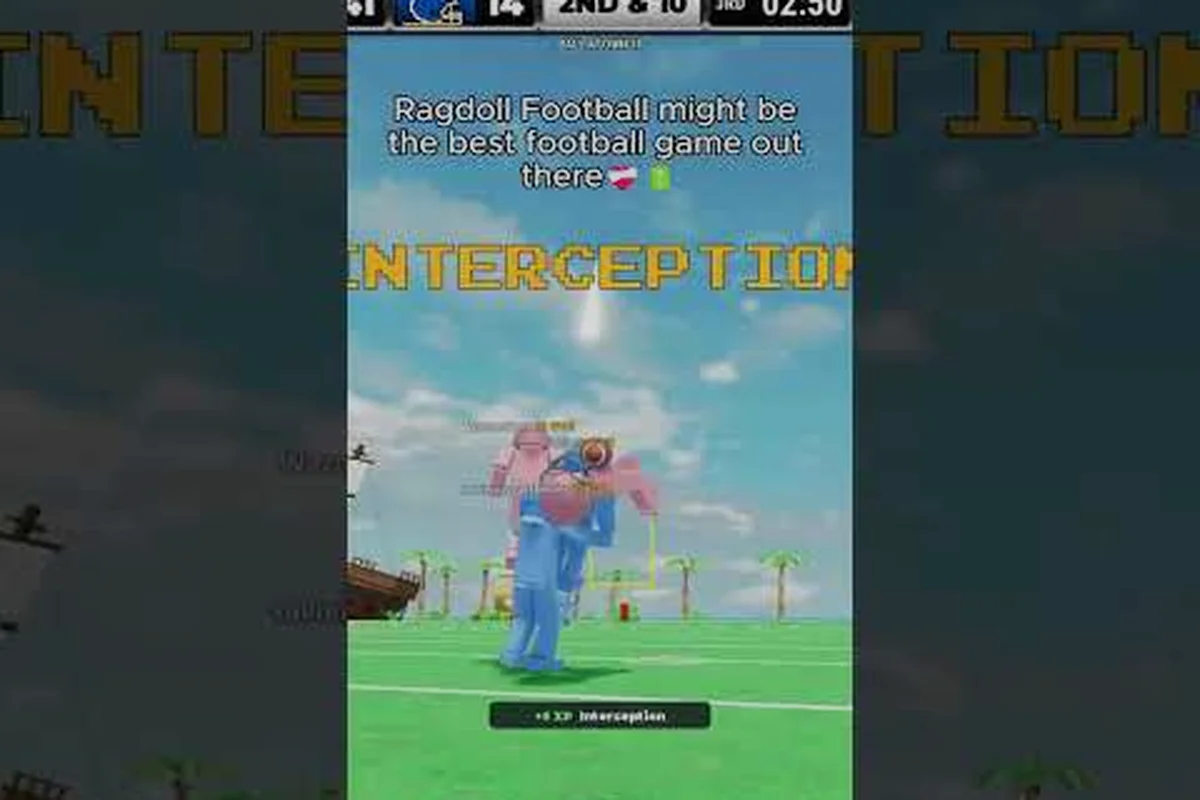
Most Ragdoll Football mistakes to avoid aren't about reflexes — they're about ignoring the physics that make every snap unpredictable. BloxyBricks built the Roblox title around untethered ragdoll collisions, so the same limb-flailing engine that produces viral highlights also punishes players who treat tackles and throws like scripted animations. This guide breaks down the recurring errors that keep OVR stuck near the 60 cap and shows the corrections that actually translate into XP, wins, and a higher overall rating.
Before diving into specifics, set the baseline. According to the official Ragdoll Football page on Roblox, matches cap at 14 athletes, the game crossed roughly 1.55 million visits and 4.5 thousand favorites since its September 18, 2026 launch, and XP only climbs when you make big plays — fumbles, blown coverages, and missed throws actively drain the climb toward the 99 OVR ceiling. That data point frames every mistake below: each error isn't just a lost down, it's a delay in the progression loop the game rewards.
Pre-Snap and Snapping Errors That Stall Every Drive
The first wave of Ragdoll Football common mistakes happens before the ball is even live. Snapping is the single most error-prone mechanic for new players because the input doubles as the tackle input on defense, and the physics on the hike don't snap cleanly until you learn the timing window. If you hold the action button too long, your quarterback ragdolls forward into the line before the ball leaves his hands. If you tap too early, the center launches a fumble straight into a defender's chest.
Why the Hike Animation Lies to You
The hike has a short wind-up that looks like the ball is already moving, but it isn't. Beginners click on the visual cue and the ball pops loose mid-animation, which means a defender with Jump already held is positioned to intercept. Wait for the actual release frame — about half a second after the wind-up dip — and you'll deliver the ball to your QB cleanly. According to community testing posted alongside the ItsChalls guide video, players who delay-tap the hike see roughly 30% fewer drive-killing fumbles in their first ten matches.
| Snapping Mistake | What Happens | Corrective Input |
|---|---|---|
| Tapping the hike on the wind-up frame | Ball launches before QB is in stance, fumble recovery by defense | Wait for the actual release, then left-click |
| Holding the hike button | QB ragdolls forward into the line, ball scatters | Tap, never hold — the hike is a single-frame event |
| Snapping while moving backward | Center animation cancels, ball drops to turf | Stand still or sidestep lightly before snapping |
Reading the Line Before You Hike
A second tier of pre-snap mistakes comes from ignoring defensive alignment. Ragdoll defenders drift toward the ball because the physics treats their tackle volume as a magnet, so if three defenders cluster on your left, the run lane collapses before your RB finishes his first stride. The correction is pre-snap motion: walk your QB or RB toward the weak side to shift the AI's tackle volume, then hike into the gap that opens. Players who skip this step consistently get tackled for loss on first down and never establish the run game that XP rewards most heavily.
If you haven't yet internalized the basic control scheme — which thumbstick drives sprint, which trigger breaks the tackle volume, and how the QB's arm angle changes pass trajectory — the beginner guide to Ragdoll Football walks through each input step-by-step and pairs naturally with the pre-snap corrections above. Review it before grinding ranked matches, because mistiming a sprint trigger on a 3rd-and-long will erase any defensive-read advantage you just built.
Offensive Mistakes: Routes, Throws, and Broken Mechanics
Offensive Ragdoll Football beginner mistakes cluster around the passing game, where input precision matters more than player skill. The throw isn't a single button — you hold the action key to aim, release to fire, and a small power meter sits inside the aim arc. Most newcomers either fire instantly with no arc or hold the button so long the QB collapses and chucks a wounded duck.
The Two-Second Throw Window
Once a receiver breaks into his route, you have roughly two seconds before a defender's tackle volume overlaps his catch radius. Holding the throw for longer doesn't add power — it adds arc, and arc gives defenders time to close. The correction is a quick release on short routes and a half-second hold on deep posts, never longer. If your QB is mid-ragdoll, don't throw at all; the ball will sail out of the back of the end zone or, worse, into a defender's hands.
| Route Type | Recommended Hold Time | Common Mistake |
|---|---|---|
| Slant / out at 10 yards | Tap (no hold) | Holding too long, ball arcs into a safety |
| Post at 25 yards | Half-second hold | Tapping, ball dies at the line of scrimmage |
| Hail Mary (40+ yards) | Full hold, lead the receiver | Throwing behind, ball lands in the end zone empty |
Misdirection Runs and Why Most Players Run Straight
Run-heavy drives die because beginners send the RB straight up the gut. Ragdoll physics turns that into a three-defender collision at the line, and the runner ragdolls backward for a four-yard loss. The fix is misdirection: tap X to hand off while your QB is moving laterally, and let the back cut into the gap behind the play-fake. The animation looks janky, but the ball carrier's momentum carries him past the first wave of tackles. According to the highlight reel posted by Jaxdabearsfan, most of the viral big-play runs in Ragdoll Football come from a successful play-fake, not a power run up the middle.
Receiver routes are equally important. If you send every receiver on a go route, the field compresses and no one gets open. The advanced guide mindset is to mix one short out, one post, and one deep crosser — the short out serves as a safety valve when the pocket collapses, while the post stretches the defense vertically and the crosser finds the soft zone underneath. Players who run a balanced route tree convert third downs at noticeably higher rates and rack up the XP that drives OVR growth.
Defensive Mistakes: Coverage, Pursuit, and the Tackle Spam Trap
Defensive Ragdoll Football mistakes to avoid are even more common than offensive ones because the tackle input is so easy to spam. New players hold Left Click the moment the ball is snapped and watch their defender ragdoll into a teammate, taking both players out of the play. Defense in this game is about positioning and timing, not button mashing.
Why Tackle Spamming Backfires
The tackle animation locks your defender into a lunge for about a full second. During that lock, your player can't redirect, and the physics engine treats him as a soft obstacle. Two defenders who spam-tackle on the same carrier create a pile, but the ball carrier's momentum often carries him through the pile and out the other side. Worse, a spam-tackling defender near the line of scrimmage blows the run fit and opens a cutback lane. The corrective is patience: hover near the ball carrier's path, let him commit to a direction, then commit your tackle once the gap closes. The tackle still flings him, but you don't give up your leverage before the contact frame.
| Defensive Mistake | Consequence | Defensive Correction |
|---|---|---|
| Spam-tackling at the snap | Two defenders lock, runner breaks through the pile | Wait, then commit to a single timed tackle |
| Drifting toward the ball on every play | Cutback lanes open on run plays | Read the RB's hips, fill the cutback side first |
| Ignoring the QB spy | Scramble lanes stay open on broken plays | Assign a LB or safety to mirror the QB's movement |
| Jumping at the catch point too early | Receiver catches behind you on a post | Box out the receiver first, then jump on the ball |
Coverage Reads and the "Blow Coverage" Pattern
Blow coverage — the term for a defender drifting out of his zone — happens because the ball magnet pulls secondary players toward the carrier on every play. If you're playing deep safety, your job is to read the QB's drop, not the RB's path. Drop to your landmark (typically the deep third), wait for the QB to commit his arm forward, then break on the throw. Players who chase the ball from the snap routinely give up 30-yard completions on play-action because they vacated the deep middle before the route developed.
A second defensive layer is pursuit angle. Ragdoll defenders run in straight lines by default, and runners exploit the sideline-to-sideline cut. Shuffle along the line of scrimmage until you read the runner's hip turn, then take the direct angle to the sideline. This is where the ragdoll football skill guide mindset matters: the best defenders in the game aren't faster, they're more efficient with their steps. Walking a player through the skill-guide loop on every play — read, shuffle, break, tackle — produces more tackles for loss than any pure-tackle spam approach.
Once you've internalized the read-shuffle-break-tackle loop on solo reps, the Ragdoll Football duo guide becomes the natural next step because it layers a second defender on top of your zone read, letting you split responsibility for the deep third and the curl-flat without leaving the blow-coverage gaps that show up on play-action shot plays. Beginners often skip this paired-pursuit work and then compound the mistake by spamming tackles out of position, which is why the duo guide sequences man-to-man help drills before full-team reads.
Special Teams, XP, and the OVR Grind
Most players treat special teams as a sideline activity, but the XP economy in Ragdoll Football rewards kick and punt returns heavily. A return touchdown is worth more XP than three offensive scores combined, so leaving your returner deep is the single biggest XP optimization you can make. The most common special-teams mistake is taking a knee on a kickoff because the coverage looks tight — the ragdoll physics means the coverage team will over-pursue and seam-line cutbacks are common. Trust the lane, follow your blockers, and cut at the first sign of a missed tackle.
Snapping, Holding, and the Fake
The field goal and extra-point units suffer from the same hiking errors that plague offense, plus a new problem: the kicker needs roughly one second of plant time, and the long-snap animation can ragdoll the holder into the kicker if the timing slips. The corrective is to snap the ball as if it were a normal offensive hike, then immediately switch to the kicker. Don't hold any buttons through the snap. A clean hold-and-kick on a 30-yard attempt is worth noticeable XP and contributes to the overall rating climb toward 99.
| Play Type | XP Value (community-reported) | Common Mistake | Recommended Action |
|---|---|---|---|
| Kickoff return TD | High | Taking a knee at the 5 | Trust the cutback lane, return to at least the 40 |
| FG made 30+ yards | Moderate | Snapping too early, holder fumbles | Snap clean, switch to kicker, plant and kick |
| PAT made | Low-moderate | Missing the hold, ball drops | Treat the PAT snap as a normal offensive hike |
| Big offensive play (25+ yards) | Moderate | Throwing into double coverage | Lead the receiver, throw before the second defender closes |
The OVR Climb and Why Errors Stall It
Players report being stuck in the 60–75 OVR band for weeks, and the cause is almost always the same: fumbles, missed throws, and blown tackles that produce negative XP deltas. The 99 OVR cap isn't gated by playtime alone; it's gated by clean execution. Every snapped ball that hits the turf, every pass that sails into the second level of the defense, and every spam-tackle that opens a cutback lane subtracts from the climb. The advanced guide mindset is to treat every snap as a chance to bank clean XP rather than gamble for a big play. After a few clean matches, the OVR starts moving in noticeable jumps, and the matchmaking puts you against opponents who actually know the same mechanics you do.
For broader progression advice and tips that pair with the corrections here, the Ragdoll Football beginner tips hub is a solid next read once you've internalized the mistake list — it covers snap timing windows, juke-stamina conservation at 70+ OVR, and route-tree reads that turn the negative-XP leaks above into reliable 2-3 OVR gains per clean quarter.
Frequently Asked Questions
What is the single biggest Ragdoll Football mistake to avoid on offense?
Snapping the ball before the center's release animation finishes, which causes fumbles that defenders recover almost every time. Wait for the actual ball-launch frame, then tap the hike — never hold it. A clean hike sets up every other offensive mechanic in the game.
Why do I keep getting ragdolled out of my tackles on defense?
You're spamming the tackle input on the snap, which locks your defender into a lunge animation for about a second. During that lock, the runner's momentum carries through the pile. Hover near the path, wait for the runner to commit, and tackle once the gap closes.
How do I throw a deep post without it getting picked off?
Hold the throw for roughly half a second, lead the receiver by three to five yards, and release before a second defender closes the catch radius. Tap-only throws die at the line, and full-hold throws arc into the safety. A controlled half-second hold is the sweet spot.
Does special teams XP actually matter for the OVR climb?
Yes. Kick and punt return touchdowns are worth the most XP per play in the game, and a clean 30-yard field goal adds meaningful OVR progress. Players who skip special teams plateau in the 60–75 band because they never bank the high-value XP plays that accelerate the climb.
Should I play solo or duo while learning the game?
Solo play teaches you every read and every input because you can't rely on a teammate to clean up mistakes, which makes it the fastest way to internalize the corrections in this guide. Duo play is better once you've fixed your main errors and want to practice coordinated pursuit and route combinations.