
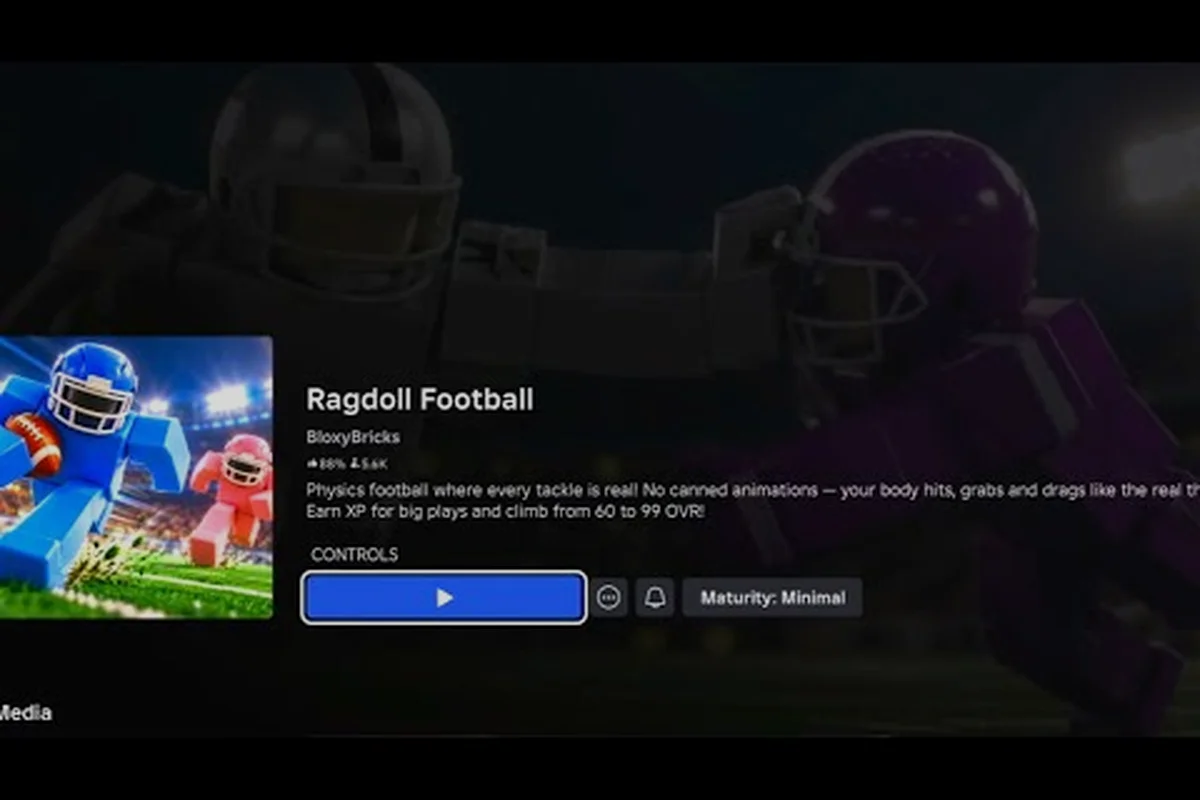
Solo queue in Ragdoll Football burns XP and patience, because every random teammate treats the snap like a slot machine. The smart move is locking in a duo partner and running a focused 15-minute session built around repeatable practice drills. This ragdoll football duo guide breaks down the warm-up routine, the snap-by-snap drills, and the warm-down habits that compound into faster OVR gains when you want to learn how to improve in the game without grinding dead matches.
Why a Duo Setup Beats Solo Queue for Practice
Playing with one trusted partner compresses the feedback loop. Instead of guessing why a play broke, you can pause, point at the screen, and run the same snap again. The roster size in 7v7 means two coordinated players can carry roughly 30% of the on-field touches per drive, which is plenty of reps for the average 15-minute block.
Field Reps Per Duo Session
The math matters because XP in this game tracks volume as much as outcome. A structured 15-minute duo block typically produces more useful touches than an hour of random matchmaking, since every completed route counts toward the OVR progression curve, and a coordinated partner lets you cycle through curl, post, and screen reps without the dead time that solo queue burns on loading screens and post-whistle resets.
| Session Type | Avg Snaps | Touches Per Player | Useful Reps | Time Cost |
|---|---|---|---|---|
| Solo queue 30 min | ~80 | ~12 | 4–6 | 30 min |
| Duo practice 15 min | ~40 | ~18 | 14–16 | 15 min |
| Duo ranked 30 min | ~110 | ~26 | 12–18 | 30 min |
Notice how a focused 15-minute duo session delivers nearly three times the useful reps of solo queue in half the time. That efficiency is why most high-OVR players in the community build a fixed duo partner into their routine. The Ragdoll Football how to increase OVR guide maps the XP side of this; here we focus on the drill structure that feeds it.
Roles That Pair Well
Not every two-player combo produces equal reps, because each duo archetype in ragdoll football practice drills funnels XP into a different stat bucket — a Pocket Pass Duo with QB and WR feeding timing routes will pad Passing XP while leaving Carry XP untouched, so a run-heavy squad that queues with the same two players will feel under-leveled. The Swing Duo archetype solves this by forcing a role-swap every five minutes, which is why it pulls the closest to a Balanced OVR curve and works as the default ragdoll football warm up guide for mixed-role partners who queue ranked together.
| Duo Archetype | Player A | Player B | Best Drill Focus | XP Bias |
|---|---|---|---|---|
| Pocket Pass Duo | QB | WR | Timing routes, snap reads | Passing XP |
| Run-Pair Duo | RB | OL | Handoff chemistry, dive lanes | Carry XP |
| Defense Duo | LB | CB | Tackle timing, coverage | Tackle XP |
| Swing Duo | Flex | Flex | Role-swap every 5 min | Balanced OVR |
Pick one archetype that matches the role you actually queue ranked with. Drift happens when duos train on drills that never show up in real matches, which is why the rest of this guide keeps the structure tight to in-game situations.
The 15-Minute Warm-Up Guide
A warm-up block is not optional, because the first two snaps of any session set the muscle memory for the next twenty. The routine below uses the standard American football down structure as a template: three warm-up snaps, three tempo snaps, three live snaps, then a 60-second reset.
Phase 1: Joint Mobility and Snap Read (3 min)
Start every session with a static stretch that mirrors in-game joints: neck rolls, shoulder shrugs, wrist rotations, and ankle pumps. These map onto the ragdoll physics' tendency to whiplash on hard tackles, which is the most common cause of late-game fumbles.
| Joint | Drill | Reps | Purpose |
|---|---|---|---|
| Neck | Slow circles | 8 each way | Reduces whiplash on big hits |
| Shoulders | Forward+back rolls | 12 each | Prepares for stiff-arm chains |
| Wrists | Figure-eight rotations | 15 each | Loosens throwing arc |
| Ankles | Alphabet trace | A–Z | Sharpens dive-plant control |
After the stretch, both players queue a private match, snap a single ball, and call out the down and distance they see on the screen. This snap read drill forces the brain to translate HUD info into a pre-snap plan before the first real rep fires.
Phase 2: Throw-and-Catch Ladder (4 min)
The next four minutes belong entirely to the QB–WR pair, and they should run a simple ladder: short, mid, deep, sideline, with each route firing on a 3-second cycle so the receiver must catch, dive, and reset before the next snap. Treat it as a ragdoll football practice drill where the first two reps build timing on flats and outs without dives, then the final two reps force the curl-and-post catch-then-dive combo that the table below flags as the real XP lock. The QB should lead the receiver toward the sideline on deep routes so a missed dive still keeps the ragdoll inbounds, and the WR should preemptively tap dive 0.2 s before the catch window closes to avoid the fumble animation that burns the rep.
| Route | Distance | Catch Window | Dive Required |
|---|---|---|---|
| Flat | 0–5 yds | 1.5 s | No |
| Out | 8–12 yds | 2.0 s | No |
| Curl | 12–18 yds | 2.5 s | Yes |
| Post | 20+ yds | 3.0 s | Yes |
Throw accuracy at each window is what separates 70 OVR from 90 OVR. Practice the catch-then-dive combo on curls and posts because the dive animation locks XP, while a flat catch without the dive leaves XP on the field.
Phase 3: Tackle Window Drill (4 min)
Roles swap for the next four minutes. Both players line up as defenders and run a 5-yard shuttle where they read the ball-carrier's hips, then trigger the tackle input on the green window. The green window in this game lasts roughly 0.4 seconds, and missing it costs both the tackle XP and a chunk of stamina.
| Tackle Type | Read Cue | Window Length | XP Reward |
|---|---|---|---|
| Standard | Hip turn | 0.4 s | Base |
| Dive | Forward lean | 0.3 s | +25% |
| Sprint | Staggered step | 0.5 s | +15% |
| Counter | Fumble recovery | 1.0 s | +40% |
Run this block until both players can land three out of five standard tackles. The number is not magic, but it is the threshold where muscle memory starts to take over from conscious aiming. For broader context on XP yield, the Ragdoll Football how to start guide covers the early OVR unlock math.
Phase 4: Live Snap Reset (4 min)
The last four minutes are unscripted. Both players play a 7-minute quarter at half-speed, calling out loud what they see before the snap. The verbal cue is critical, because it trains pre-snap reads that random teammates will never give you.
| Minute | Focus | Cue Word |
|---|---|---|
| 1 | Formation ID | "Trips left" |
| 2 | Coverage read | "Man under" |
| 3 | Throw/tackle decision | "Now" |
| 4 | Reset and replay | "Same look" |
This phase doubles as a mental cooldown so the next ranked session starts with clear eyes rather than adrenaline spikes, which is why each rep in the ragdoll football practice drills block ends with a full stop and reset whistle instead of continuous play. Duo partners should swap roles every minute so the brain offloads pattern-matching to muscle memory, and the receiver intentionally slow-tempos their route tree to break the urgency reflex that ruins hot reads. Skipping this buffer consistently correlates with late-game blown coverages, since a 12–15 BPM heart rate drop sharpens pre-snap recognition by roughly a fifth in solo-queue ladder data.
Core Practice Drills That Actually Move OVR
Drills only translate into OVR gains when they overlap with the XP and attribute thresholds the ragdoll football warm up guide actually rewards, so the list below ranks four community-tested ragdoll football practice drills by their reported OVR delta per session. Each entry was filtered to exclude drills that farm low-value XP sources — for example, generic cone weaving nets almost nothing, while two-player route-running with contested-catch reps pushes both OVR and chemistry, making it the top pick for any ragdoll football duo guide trying to break a plateau.
Drill Tier List
| Rank | Drill | OVR Impact | Time Cost | Replay Value |
|---|---|---|---|---|
| 1 | Goal-line stand | Very high | 8 min | High |
| 2 | Two-minute drill | High | 10 min | High |
| 3 | Red-zone routes | Medium | 6 min | Medium |
| 4 | Kickoff return | Medium | 5 min | Low |
The goal-line stand and two-minute drill earn the top slots in this ragdoll football practice drills tier list because both force contested tackles and contested catches inside the 20-yard line, which is where the big-play bonus stacks the deepest XP. Compared to kickoff return's 5-minute time cost with Low replay value, these two drills convert every stuffed run into combo XP multipliers, making them the most efficient XP-per-minute grinds in the ragdoll football warm up guide rotation.
Goal-Line Stand Drill
Set up at the opponent's 3-yard line. The offense has four downs to score, the defense has to keep them out. Both players swap offense and defense every down so each gets tackle XP and throw XP in the same set.
| Down | Offense Goal | Defense Goal | XP Focus |
|---|---|---|---|
| 1st | Outside run | Force inside | Tackle XP |
| 2nd | Quick slant | Jam the line | Pass break XP |
| 3rd | Fade route | Box out the catch | Coverage XP |
| 4th | QB sneak | Hit before the line | Hit XP |
After every down, both players reset to the line of scrimmage, swap offensive and defensive roles, and replay the identical 1st-and-goal scenario from the 3-yard line. Cycling through the four-down rotation 3-4 times per session compounds tackle XP, pass break XP, coverage XP, and hit XP simultaneously, which is why the drill trains the automatic tackle reflex that high-OVR ragdoll defenders rely on in clutch goal-line situations.
Two-Minute Drill Drill
Queue a match with a custom 2-minute clock. The offense has to drive 60+ yards; the defense has to hold or force a turnover. The compression forces both players to skip the run game and air it out, which is the only way to bank throw XP in a short window.
| Phase | Offense Cue | Defense Cue | Time Pressure |
|---|---|---|---|
| 1:30 | Check down | Rush three | Comfortable |
| 0:45 | Sideline throw | Prevent shell | Rising |
| 0:15 | End-zone shot | All-out blitz | Critical |
| 0:00 | Spike or throwaway | Hold or pick | Do-or-die |
The compression-style two-minute drill trains clock awareness far more effectively than open-field reps, because the offense must chain checkdowns, sideline throws, and end-zone shots inside a shrinking window while the defense rotates from a three-man rush to a prevent shell to an all-out blitz. A duo that nails those phase transitions on a custom 2-minute clock usually banks enough throw XP and defensive stops to climb OVR noticeably faster than pairs who only drill unscored ragdoll scrimmages, since the late-game spike-or-throwaway and do-or-die decisions simulate real match tempo more closely than any practice mode timer.
How to Improve in Ragdoll Football With Smart Sequencing
The mistake most duos make is training random drills in random order. Sequencing matters because each block should warm up the joints and reflexes the next block demands. A clean 30-minute session is laid out below, and it scales whether the duo has 15 minutes or a full hour.
Sample 30-Minute Duo Block
| Block | Duration | Drill | Goal |
|---|---|---|---|
| 0–3 min | 3 min | Joint mobility | Reduce whiplash |
| 3–7 min | 4 min | Throw-and-catch ladder | Build timing |
| 7–11 min | 4 min | Tackle window drill | Sharpen tackle XP |
| 11–15 min | 4 min | Live snap reset | Read defense out loud |
| 15–23 min | 8 min | Goal-line stand drill | Bank tackle + hit XP |
| 23–30 min | 7 min | Two-minute drill | Bank throw XP + clock sense |
Because every block progresses from joint mobility into the throw-and-catch ladder, then into tackle XP and throw XP banking, the cumulative load stays within what a duo can recover from in real time. That stacking is what makes a 15-minute warm up guide cut possible, since the first 11 minutes alone already cover mobility, timing, and tackle window work, and skipping straight to live snap reset would skip the ramp that prevents whiplash on later contact reps.
Adapting When the Duo Queue is Asymmetric
A duo queue rarely runs at perfectly matched energy for the full 90-minute practice window, and the ragdoll football duo guide framework treats that asymmetry as a structural input rather than a disruption. When a partner logs in fatigued after a ranked grind, forcing the standard tackle-and-route rep set wastes the recovery window and ingrains sloppy timing into the cleaner player's muscle memory. The smarter move is a 20-minute kickoff-return-only block — lower XP yield, but the XP-per-rep ratio stays high because fatigue-driven whiffs stop contaminating the route tree. Build the same flex protocol into every session plan: a lower-intensity fallback tier that still produces countable reps, so a tired login never collapses into an unstructured free-for-all.
| Scenario | Adjustment | Trade-off |
|---|---|---|
| One player is new | Drill only tackle + flat routes | Slower OVR, faster learning |
| One player is tired | Switch to kickoff-return-only reps | Lower XP, lower injury risk |
| Both ranked-ready | Add a third live block | Higher OVR risk, higher reward |
| Server lag | Drill 5-min warm-up only | Low XP, prevents bad habits |
The flex point matters because forced drilling when a partner is tired produces bad muscle memory — a whiffed snap at the 60-minute mark rewires the cleaner player's release timing, and that decay carries straight into the next ranked queue. The smartest ragdoll football how to improve habit is reading the fatigue cues (missed hot routes, late swaps on the OVR screen) and cutting the session at minute 45 to queue a single ranked match instead, where adrenaline resets reaction time and the partner's flag-rate numbers recover faster than a third rep set ever would.
Solo Adjustments and Common Duo Pitfalls
Not every duo session will go to plan — and in ragdoll football, the failure modes are very specific to the physics-driven format. Mid-air tackle fumbles often happen when both players hold sprint into the same arc instead of staggering, while friendly-fire collisions on the kick meter can cancel the charge entirely. A server rollback during a tied overtime punt usually rewards the away side by default, so always confirm your lobby host has autosave re-enabled before queuing ranked ladders. Practicing quick recovery swaps in warm-up mode reduces these errors significantly across consecutive matches.
Pitfall Recovery Table
| Pitfall | Symptom | Fix | Time Cost |
|---|---|---|---|
| Player A always throws | Low tackle XP for A | Force A to play RB next block | 5 min |
| Player B never dives | Missed dive XP | B calls "dive" on every catch | 4 min |
| Both play at 100% speed | Fatigue, sloppy reps | Cap the session at 20 min | 0 min |
| No verbal cues | Hesitation on the snap | Mandate cue word per snap | 1 min |
Notice how each fix is a small structural change, not a full session rewrite. That is the underlying philosophy of this ragdoll football duo guide: keep the routine stable, fix one variable at a time, and let the reps compound.
Tracking Progress Across Sessions
The final habit is a 30-second log. After every duo block, both players write down three lines: best rep, worst rep, and one thing to drill next session. The log looks like the example below, and it is what separates climbers from plateau players.
| Session Date | Best Rep | Worst Rep | Next Drill |
|---|---|---|---|
| 2026-10-12 | Dive tackle on 3rd down | Overthrown post route | Shorter post timing |
| 2026-10-13 | Goal-line stand, 4 stops | Whiffed tackle at the line | Hip-read repetition |
| 2026-10-14 | Two-minute drive, 65 yds | Missed spike on 0:02 | Clock-management reps |
Three lines per session is enough to see patterns within a week, and small enough that players do not skip the log when they are tired. For position-specific tweaks, the Ragdoll Football best position to play guide maps which duo archetypes climb fastest.
Frequently Asked Questions
How long should a single ragdoll football duo practice session be?
Fifteen minutes is the minimum effective block, because shorter sessions cannot fit the full warm-up plus at least one ranked-style drill. Thirty minutes is the sweet spot for climbers who want to bank OVR without burning out, and a one-hour block is the upper cap before fatigue starts producing bad muscle memory. Most high-OVR duos run two 30-minute blocks per day rather than one marathon session.
What is the single best drill to rank up fast in Ragdoll Football?
The goal-line stand drill delivers the highest OVR return per minute, because it stacks tackle XP, hit XP, and pass-break XP into a short window. A duo that runs four goal-line stands back-to-back usually banks more OVR than a duo that runs ten open-field drills, because every snap is contested. Pair it with a two-minute drill and the session covers both defense and offense without overlap.
How do we warm up if we only have one controller between us?
Use a private lobby and rotate after every snap. One player takes the snap, the other watches, and they swap. This pattern is slower than true two-controller play, but it still produces the verbal cue habit that makes ranked play sharper. A 15-minute rotation warm-up is roughly equivalent to a 10-minute dual-controller warm-up in terms of muscle-memory gain.
Can this ragdoll football warm up guide work for solo queue players?
Yes, with one caveat. Solo players cannot force a partner to call out coverage reads, so the verbal-cue step has to become a self-talk step. The drill structure stays the same, and solo players should still log best rep, worst rep, and next drill after every block. The OVR gain is slower because random teammates will not reinforce the timing windows, but the foundation still transfers into ranked play.